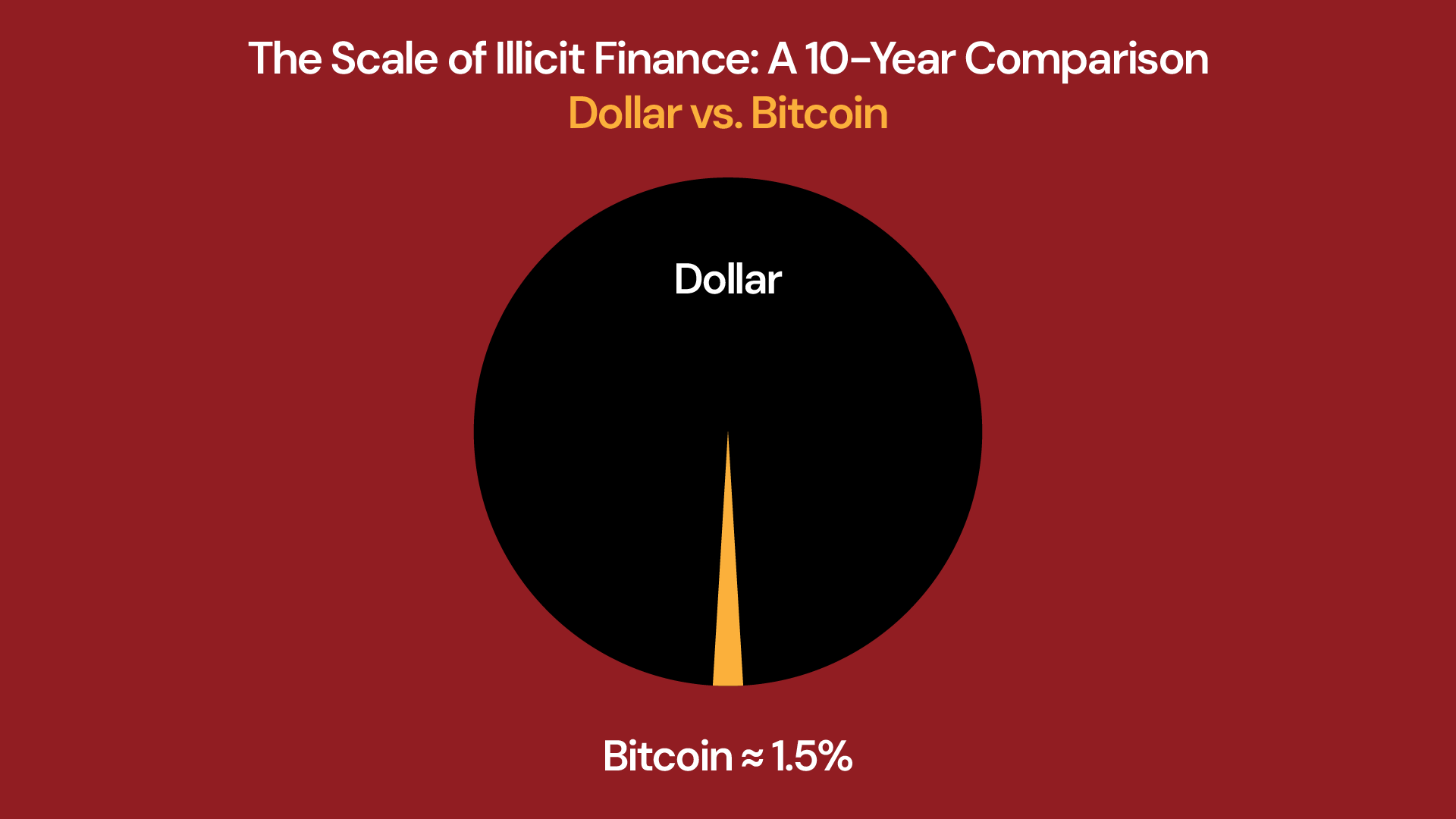
For over a decade, a massive debate has centered on the role of digital assets in illicit finance. Critics often label cryptocurrency as a primary tool for criminals, while advocates argue that traditional banking remains the preferred choice for bad actors.
When looking at the hard data provided by official global regulators—including the United Nations, the US Treasury, and the Financial Action Task Force (FATF)—the reality is clear: the US dollar remains the undisputed king of money laundering.
The Scale of Illicit Finance: A 10-Year Comparison
| Metric / Indicator | The US Dollar ($) | Bitcoin (BTC Only) |
|---|---|---|
| AnnualVolume | $800 Billion to $2 Trillion+ | $10 Billion to $30 Billion |
| BTC as % of USD Volume | 100% | ~1.25% to 1.5% |
Data sources compiled from UNODC, US Treasury, FATF, and FinCEN reports.
The US Dollar: The Preferred Choice for Global Cartels
According to the United Nations Office on Drugs and Crime (UNODC), between 2% and 5% of global GDP is laundered through traditional financial networks every year. Because the US dollar serves as the world’s primary reserve currency, it bears the overwhelming majority of this weight.
- The Scale Problem: At its lowest estimate ($800 billion), the annual amount of fiat currency laundered is larger than the entire market capitalization of Bitcoin during several periods of its history.
- Institutional Gaps: The US Department of the Treasury’s National Money Laundering Risk Assessments consistently point out that professional money launderers rely heavily on traditional infrastructure. They exploit retail banking, bulk cash smuggling, and opaque legal entities to hide ownership.
- Low Enforcement Yields: UNODC data reveals that law enforcement agencies manage to intercept and freeze less than 1% of illicit fiat flows globally, meaning the vast majority of laundered cash successfully enters the legitimate economy.
Bitcoin: Transparent, Traceable, and Imperfect for Crime
While bad actors certainly use Bitcoin—especially in cases of ransomware, darknet markets, and cyber scams—its underlying technology presents a massive challenge for long-term money laundering: the blockchain is a permanent public ledger.
- Microscopic Footprint: Joint reports from Europol and FinCEN show that illicit activity on the Bitcoin network peaked around 2.1% of its total transaction volume in 2019. In recent years, that number has regularly hovered near or below 1%.
- The Visibility Trap: Unlike cash or hidden Swiss bank accounts, every Bitcoin transaction is broadcast to the world. Law enforcement agencies use advanced blockchain analytics tools to trace funds across thousands of addresses simultaneously.
- High-Profile Seizures: The public nature of the blockchain has allowed government agencies (like the IRS and FBI) to execute multi-billion-dollar historic seizures of stolen or laundered Bitcoin. Doing the same in the traditional banking sector often requires years of international legal battles to pierce corporate veils.
Conclusion
While regulatory bodies like the Financial Action Task Force (FATF) continue to tighten rules around virtual assets to prevent criminal abuse, the data shows that Bitcoin is an inefficient tool for large-scale money laundering. For the foreseeable future, the sheer volume, anonymity, and institutional gaps of the traditional fiat system make the US dollar the asset of choice for international financial crime.